Economic Policy
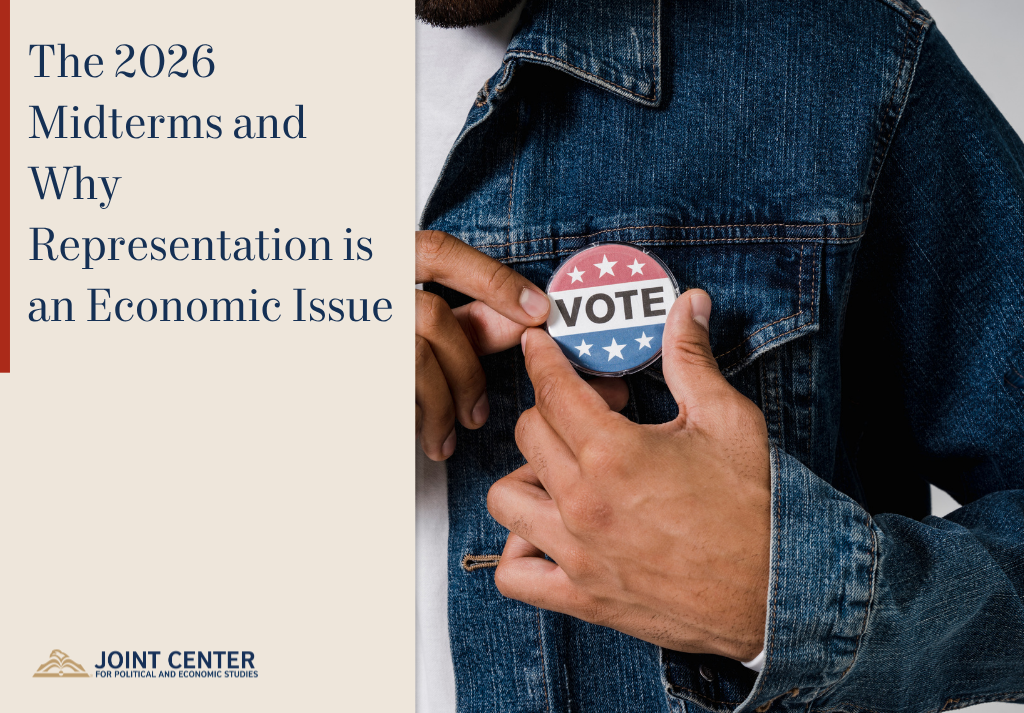
The 2026 Midterms and Why Representation is an Economic Issue
By Sydney Dowd, Student at University of California, Santa Barbara & Former Joint Center Intern
Introduction
As the 2026 midterm elections approach, questions about political representation are moving back to the center of public attention. But representation is not only a political issue. The officials voters send to government help shape legislative priorities, oversee public institutions, and make decisions about investments and policies that affect jobs, housing, transportation, education, and long-term economic security.
Economic opportunity is often discussed in terms of education, employment, and savings. Less attention is paid to the role political representation and civic participation can play in shaping the opportunities available to communities. Civic participation allows individuals to influence decisions that affect their daily lives, whether it be through voting, attending meetings, or advocating for policy change. All of these influence political representation, which in turn shapes the policies and public resources that affect economic opportunity. The Supreme Court’s ruling in Louisiana v. Callais has renewed debate about voting rights and political representation, particularly for Black communities.1
On April 29, 2026, the Supreme Court of the United States affirmed a lower-court ruling that Louisiana’s 2024 congressional map, which created a second majority-Black district, was an unconstitutional racial gerrymander.2 The decision also changed the legal framework governing certain Section 2 redistricting claims. The case raises broader questions about how electoral rules shape communities’ opportunities to elect representatives and influence public policy. For Black communities, civic participation has long been a critical tool for advancing political representation and influencing public policy. In 1947, only 2.6 percent of Black voting-age Louisianans were registered to vote. That share rose to 31 percent by 1956 and reached 47.1 percent by 1966, the year after the Voting Rights Act was enacted.3 This steady increase reflects both years of grassroots organizing and the legal protections that expanded political participation and, in turn, strengthened Black communities’ voices in government.
Political representation and civic participation can influence economic opportunity through policies that shape people’s access to resources and institutions. Elected officials help determine which communities’ concerns receive legislative attention, how public resources are allocated, and how governments respond to community needs.
Historical Role of Black Civic Participation
Black civic participation has been a driving force for change in American democracy through direct protest, the fight for equality, and the building of institutions. One of the most consequential periods was the civil rights movement from the mid-1950s through the 1960s. Whether it was the NAACP’s legal campaign that produced Brown v. Board of Education, the Montgomery bus boycott, or the March on Washington, civic participation reached far beyond simply voting on a ballot. During Freedom Summer in 1964, the Council of Federated Organizations coordinated a major voter-registration campaign in Mississippi, with the Student Nonviolent Coordinating Committee playing a leading role. About 1,000 volunteers participated.4 The campaign helped build the pressure and public attention that contributed to passage of the Voting Rights Act of 1965, which suspended literacy tests in jurisdictions with histories of discrimination and strengthened federal protection of voting rights.5
Black civic participation and the civil rights movement also advanced economic opportunity through protections and policies affecting employment, education, housing, and wealth. Title VII of the Civil Rights Act of 1964 prohibited employment discrimination on the basis of race, color, religion, sex, or national origin.6 Employment protections matter economically because discrimination can prevent Black workers from obtaining certain jobs, advancing into higher-paying positions, or receiving equal treatment in the workplace. The Fair Housing Act prohibits housing discrimination based on race, color, national origin, religion, sex, familial status, and disability.7 Housing protections also had economic consequences because access to homeownership can affect whether families are able to build equity, pass wealth to future generations, and live near well-funded schools and employment opportunities. These reforms show that increased civic participation did more than expand voting rights. It helped secure policies that improved access to employment, housing, and education, all of which are fundamental components of economic opportunity.
Why Representation Matters
The Supreme Court’s decision in Louisiana v. Callais has created a conversation about more than just congressional district maps. The decision has prompted debate about whether Black voters in Louisiana will continue to have the same opportunities to elect candidates of their choice and how future voting rights challenges may be evaluated. Because elected officials influence funding decisions and policy priorities, changes in political representation may also affect how effectively communities advocate for policies that expand economic opportunity.
Representation can have measurable effects on public policy and government spending. A 2023 study examining the effects of the Voting Rights Act on local governments in the South found that VRA coverage increased Black representation in county commissions and, in counties with district elections, was associated with faster growth in capital spending.8 Because county commissions control local budgets, the findings illustrate one way political representation can affect decisions about public resources. Investments in transportation, workforce development, housing, and other services can shape residents’ ability to reach jobs, obtain training, and maintain economic stability. These questions matter against the backdrop of persistent economic disparities. In September 2026, the Black unemployment rate rose to 7.0 percent, compared with 4.2 percent overall.9 These disparities reflect many factors beyond political representation, but public policy can affect many of the conditions that shape access to employment and economic mobility. Political representation gives communities an avenue to advocate for policies and resources that respond to their economic needs.
Public-resource allocation is another channel through which representation can affect economic opportunity. The Infrastructure Investment and Jobs Act provided approximately $1.2 trillion for transportation and infrastructure, including $550 billion in new federal investments.10 For many formula programs, state transportation departments and other implementing agencies exercise meaningful discretion within federal eligibility and planning requirements.11 Those choices can determine which community needs receive attention and which investments are made first. While many factors influence funding decisions, political representation can affect which priorities are elevated when public resources are allocated.
Representation also matters in how governments respond to community needs. Decisions about zoning, housing trust funds, public housing investments, education, healthcare, and employment policy can all affect economic opportunity. Civic participation gives residents a way to communicate those needs, provide information about local conditions, and press policymakers for responses that reflect community priorities.
Looking Ahead to the 2026 Midterms
The approaching midterm elections provide a timely reminder that civic participation does not begin and end at the ballot box. To strengthen civic participation, we must not simply look at voter turnout. Civic engagement should be encouraged by expanding civic education, increasing opportunities for youth engagement, supporting community organizations, and making local government more accessible. CIRCLE surveys found that young people who recalled being encouraged to vote or taught how to register in high school reported higher levels of voting and other civic participation later on.12 Through public meetings, advisory boards, and community forums, residents can have more of an opportunity to participate in the policymaking process and hold elected officials accountable.
Louisiana v. Callais serves as a reminder that debates over voting rights are debates about representation and democratic participation. Meaningful civic participation remains one of the most effective ways communities can influence public policy, advocate for their priorities, and help shape economic opportunity for future generations.
Conclusion
As voters prepare for the 2026 midterm elections, representation is about more than who wins a seat in government. It shapes who has a voice, whose concerns receive attention, and how public institutions respond to the needs of different communities. The legal implications of Louisiana v. Callais will continue to unfold, but the broader economic stakes are already clear: political representation can affect the policies and public investments that shape opportunity.
For Black communities, history has shown that sustained civic participation can expand political representation and influence public policy. From the civil rights movement to today, advocacy, organizing, voting, and community leadership have helped shape the policies and public resources that affect economic security and wealth.